Vancouver Real Estate Market Update: March 2026

Vancouver Real Estate Market Update: March 2026
A Wait-and-See Market With Some Interesting Divergences Below the Surface
The Metro Vancouver real estate market continues to keep both buyers and sellers on their toes this spring. While headlines point to a market in waiting, a closer look reveals some intriguing shifts beneath the surface.
In March 2026, home sales registered on the MLS® in Metro Vancouver totaled 2,032—a 2.8 per cent decrease from March 2025. This pace remains roughly three per cent below last year and sits a significant 31.8 per cent under the 10-year seasonal average. According to Andrew Lis, chief economist for Greater Vancouver REALTORS®, this trend isn’t surprising. "Year-to-date, sales are tracking our forecast for the year closely, and the weakness in demand we continue to observe at the aggregate level is unsurprising," Lis notes. But he also points out a growing divergence: while multifamily sales are lagging, the detached segment is showing signs of life, with sales up and new listings down compared to last year.
Inventory tells its own story. There were 5,792 new listings in March 2026—a 10.3 per cent decrease from the previous year, but still 4.9 per cent above the 10-year average. The total number of properties listed for sale reached 14,774, a modest 1.6 per cent increase over last year and a striking 38 per cent above the decade average. This means buyers have more options than usual, even as fewer sellers step into the market compared to last year.
The sales-to-active listings ratio for March 2026 sits at 14.2 per cent overall, with detached homes at 11 per cent, attached at 17.2 per cent, and apartments at 15.7 per cent. Historically, prices tend to fall when this ratio stays below 12 per cent and rise when it’s above 20 per cent for several months. Right now, the market is in a balanced zone—neither strongly favoring buyers nor sellers.
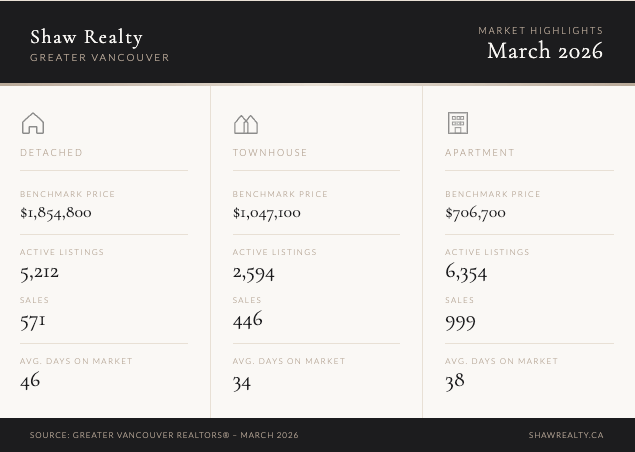
Prices have softened compared to last year but remain steady month-over-month. The MLS® Home Price Index composite benchmark for all residential properties is $1,104,300—a 6.8 per cent decrease from March 2025, but up 0.4 per cent from February 2026. Detached home sales climbed to 571, an 8.3 per cent increase from last year, with a benchmark price of $1,854,800 (down 8.2 per cent year-over-year, up 1 per cent from last month). Apartment sales reached 999, a 7.8 per cent drop from March 2025, with a benchmark price of $706,700 (down 7.8 per cent year-over-year and down 0.2 per cent from February). Attached home sales totaled 446, down 5.5 per cent from last year, and the benchmark price for townhouses is $1,047,100 (down 5.7 per cent year-over-year, up 0.1 per cent from February).
So, what’s keeping things in this holding pattern? Lis explains, “We continue to see fewer sellers stepping into the market than last year, which is keeping inventory levels relatively flat. Pairing this dynamic with sales remaining below long-term averages, we’re not seeing prices move significantly in either direction.” He also points to global factors: while political uncertainty over tariffs has eased since early 2025, ongoing conflict in the Middle East is now pushing bond yields and fixed mortgage rates higher. This could dampen demand as we head into the spring market—unless there’s a swift resolution abroad.
For buyers and sellers alike, this means patience and careful strategy are key. With more inventory than usual and prices holding steady for now, it’s a market that rewards those who keep a close eye on the details and stay ready to move when the right opportunity arises.
----------
Ian Shaw | Shaw Realty | ian@shawrealty.ca | shawrealty.ca
Data sourced from the Greater Vancouver Realtors MLS Home Price Index, March 2026.
Categories
Recent Posts