Vancouver Real Estate Market Update: What 2025 Really Looked Like

Vancouver Real Estate Market Update: What 2025 Really Looked Like
If you followed the Vancouver real estate market closely in 2025, you probably noticed one thing: activity slowed — but not evenly across the region or across property types.
While headlines focused on low sales numbers, the reality on the ground was far more nuanced. Understanding what actually happened last year is key to making smart decisions in the Vancouver housing market in 2026.
Vancouver Home Sales Fell to Multi-Decade Lows
Total home sales across Greater Vancouver and the Fraser Valley finished 2025 at just over 35,000 transactions, making it the slowest year for Vancouver real estate sales in at least two decades.
This wasn’t due to a lack of demand. In fact, momentum began to build in late 2024 as interest rates eased and long-delayed buyers re-entered the market. However, ongoing economic uncertainty caused many buyers and sellers to pause before making major real estate decisions.
Detached Homes Were Hit Hardest
The slowdown wasn’t consistent across all property types.
-
Detached homes in Vancouver saw the largest drop in sales
-
Townhomes and condos also declined, but held up better overall
Affordability played a major role. As borrowing costs rose, buyers became more price-sensitive, which disproportionately affected higher-priced detached properties.
Vancouver Condo Listings Reached Record Levels
One of the most significant shifts in the Vancouver housing market in 2025 was inventory.
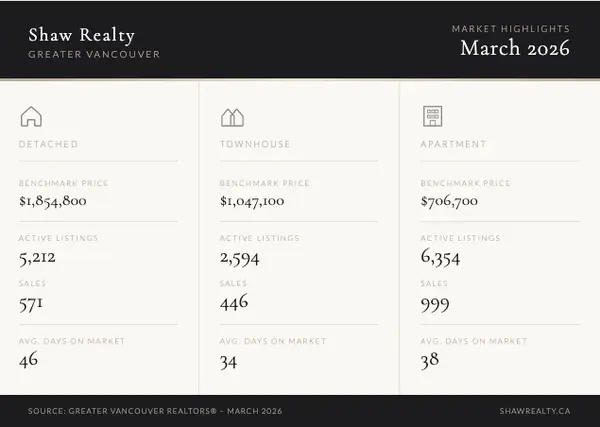
New listings surged to their highest level in over 20 years, driven primarily by a sharp increase in Vancouver condos for sale. At peak levels, active listings were the highest seen since 2012.
For buyers, this meant more choice and leverage. For sellers, it meant pricing and presentation mattered more than ever.
A Balanced Market — But Only on Paper
When looking at months of inventory across the Vancouver real estate market, the region technically hovered around balanced conditions. However, averages hide important differences.
Neighbourhoods such as North Vancouver, Squamish, and Pitt Meadows remained relatively tight, while areas like West Vancouver, White Rock, and North Delta experienced higher inventory and longer selling timelines.
This is why hyper-local market knowledge is critical when buying or selling real estate in Vancouver.
Vancouver Home Prices Softened Modestly
Benchmark home prices declined modestly in 2025:
-
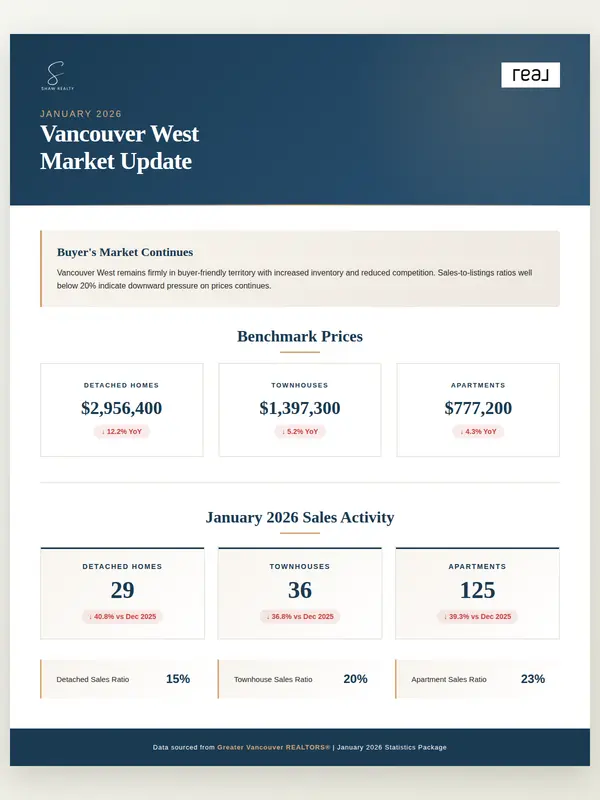
Greater Vancouver prices fell by roughly mid-single digits
-
Fraser Valley home prices declined slightly more
This was not a market correction driven by distress — it was a reset shaped by affordability, inventory levels, and buyer caution.
What the Vancouver Real Estate Outlook Looks Like for 2026
Heading into 2026, the Vancouver real estate market is best described as selective.
-
Well-priced homes are still selling
-
Buyers are informed and patient
-
Sellers need realistic pricing and a clear strategy
-
Micro-markets matter more than regional headlines
For buyers and sellers alike, success in 2026 will come down to understanding local conditions and having a tailored plan — not timing the market.
Thinking about buying or selling real estate in Vancouver in 2026?
Every neighbourhood, property type, and price range behaves differently. If you want clear, honest advice based on local market conditions, I’m happy to help.
👉 Contact me for a personalized Vancouver real estate strategy.
Market insights informed by publicly available MLS® data and industry reporting, including rennie intelligence. Interpretations are my own and not intended as an opinion of value.
Categories
Recent Posts